What Change Did This Represent of Virginia House of Burgesses
The House of Burgesses (1619-1776 CE) was the kickoff English representative government in North America, established in July 1619 CE, for the purpose of passing laws and maintaining guild in the Jamestown Colony of Virginia and the other settlements that had grown up around it.
A burgess was defined as a freeman and is too given as "citizen", defined at the time as a white male landowner over the historic period of 21. Although the Business firm of Burgesses is often divers or referenced as the beginning democratic government in North America, this is inaccurate considering:
- Democratic government was already well-developed by the ethnic people and had been in place for over a thousand years.
- The House of Burgesses was non a true democracy because but white land-owning males over the age of 21 were allowed to participate, the governor could veto any law, and all laws were subject to the blessing of the Virginia Visitor of London.
- The Quango of State, which brash the governor, was comprised of men appointed past the Virginia Visitor who had non been elected past their peers or constituency but represented their interests.
It is more accurate to define this assembly as the first English representational government in the North American colonies. Its establishment was encouraged by the English politico Sir Edwin Sandys (pronounced Sands, l. 1561-1629 CE), ane of the principal investors and founders of the Virginia Company of London which had funded the expedition to establish Jamestown in 1607 CE. Sandys was an antiroyalist – someone who rejected the concept of the Divine Right of Kings and the monarchy altogether – and supported a governmental construction that was based on the assembly of complimentary men, elected by their peers, to create and uphold laws for the mutual expert.
The House of Burgesses' showtime order of business was relations betwixt the colonists and Native Americans, and this would remain an ongoing business concern of the assembly in the following years. Although the burgesses continually sought to pass laws and enforce policies they thought fair to both indigenous peoples and immigrants, they failed to recognize that their very presence on lands previously used by Native American tribes was key to all the other problems they tried to address and, farther, equally more than lands were taken for settlements and plantations, land theft was justified by laws, addressing what was thought all-time for the indigenous people.
Many of the Founding Fathers were members of the House of Burgesses & instrumental in establishing its successor, the General Assembly.
The assembly connected to see as a unicameral political body (meaning a single legislative body) whenever chosen to guild until 1642 CE when information technology was divided into a bicameral trunk (two separate legislative assemblies) of the House of Burgesses and the Council of Land. These two houses would go more well-defined and autonomous over the years and served as the nexus for opposition to British rule by the colonies in the tardily 18th century CE.
Many of the Founding Fathers, including George Washington, Thomas Jefferson, and Patrick Henry, were members of the Firm of Burgesses and instrumental in establishing its successor, the General Associates, comprised of a Senate and a Business firm of Delegates in 1776 CE. A number of scholars in the modern era take argued for the merits that the House of Burgesses, which informed the creation of the U.s.a. regime, was directly influenced by Native American forms of authorities, only this merits is consistently challenged.
Native American Democracy
A democratic form of government had been established in North America over a k years before the first English colonist set foot on the land. Although many ethnic nations practiced this grade of government, it is all-time documented for the Iroquois Confederacy (likewise known as the Haudenosaunee) which stretched from modern-day Canada down through N Carolina. The tribes once fought each other in near-constant wars over nutrient and water supplies until the arrival of the Bully Peacemaker, Dekanawida, who inspired his two best-known disciples – Hiawatha and, later, Tadodaho – to spread the bulletin of peace and power through unity.
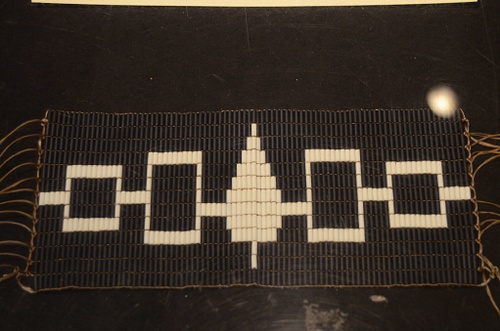
Hiawatha Belt
The Cayuga, Kanienkehaka, Mohawks, Oneida, and Seneca kickoff formed the confederacy with the Onondaga and Tuscarora joining afterwards. Scholar David J. Silverman describes the form of government, known equally a League, established c. k CE though existing in some form long earlier that fourth dimension through tribal councils:
Similar the tribal councils, League meetings of clan sachems [chiefs] focused not on policymaking but peacekeeping, specifically a halt to the cycles of revenge warfare. (42)
At the same fourth dimension, all the same, the League did, in fact, make policy as a ways toward keeping the peace. The clan chiefs were chosen by the matrons of their clan on the basis of their eloquence and power to correspond the interests of their people. Although members of the tribe did not directly elect their representatives, they trusted the matrons who chose them, and those chosen who did not faithfully stand for the interests of their clan were removed and replaced past others. Discussion of policy was encouraged, and contend was integral to whatever determination on laws, the acceptance of which had to be agreed upon unanimously. The Iroquois thereby instituted a unicameral legislative body in North America centuries before the English arrived.
Virginia Visitor, Jamestown, & Tobacco
Other tribes, from modern-day New England downward through Virginia, implemented like forms of authorities and were fully operational when England began its efforts to colonize the so-chosen New Globe of North America. The Virginia Visitor of London funded the 1607 CE expedition which established Jamestown in the marshes of Virginia on land which had been rejected as unsuitable by the Powhatan Confederacy of the region. The settlement struggled to survive and only did and then once Captain John Smith (l. 1580-1631 CE) took control, stopped the colonists from stealing from the natives, forced them to work the land for their food, and formed an alliance with the Powhatan chief Wahunsenacah (l. c. 1547 - c. 1618 CE).
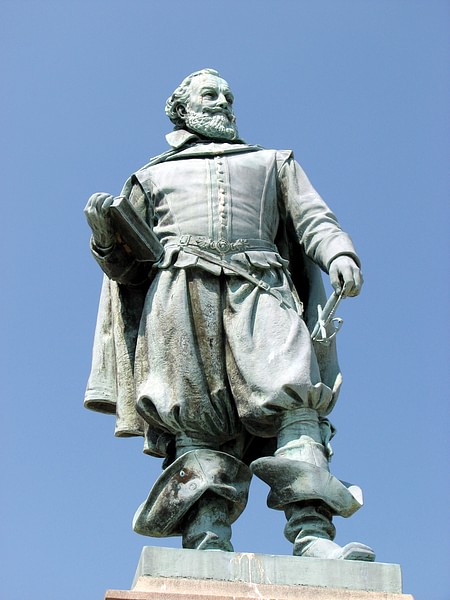
Statue of Captain John Smith
Smith left the colony to return to England in the autumn of 1609 CE, and relations deteriorated between the colonists and ethnic people. The colony suffered through what is now known equally the Starving Time during the winter of 1609-1610 CE and, in May of 1610 CE, a ship brought the homo who would turn Jamestown'south fortunes around; John Rolfe (50. 1585-1622 CE). Rolfe arrived with tobacco seeds he had somehow caused and thought would do well in the Virginia soil. He was correct and, past 1614 CE, had already harvested his first very assisting crop, which encouraged others to begin planting tobacco.
The expansion of Jamestown, as well as the neediness of the colonists and their trend to steal from the natives, had resulted in the Outset Powhatan State of war (1610-1614 CE) which ended when Rolfe married the daughter of Wahunsenacah, Pocahontas (l. c. 1596-1617 CE), establishing the Peace of Pocahontas in 1614 CE. Other settlements, such every bit Henricus, had been founded by this time, and more land was purchased (or taken) from the natives for tobacco plantations and settlements. Pocahontas died in 1617 CE, and tensions began to mountain between the colonists and natives who saw more of their land taken, and more of their crops appropriated, without compensation.
Business firm of Burgesses Established
At this point in the colony's development, Sir Edwin Sandys (who was besides responsible for the Jamestown Brides program) recognized the need for an on-site representational government to direct affairs in North America. From the kickoff, Jamestown had been led by a colonial governor appointed by the Virginia Company who fabricated decisions, sometimes, after consulting with advisors. Sandys encouraged the establishment of a legislative body that would exist better able to accost the needs of an expanding colony and encounter the challenges posed past the resistance of the indigenous people to their loss of land rights. Scholar David A. Price describes the original organization of the legislature in July 1619 CE:
No business relationship of the rules of suffrage in 1619 Virginia has survived, just it is safe to assume they followed the practice of the mother land in excluding male person indentured servants (because they were not property owners) as well equally all women. The voters of each metropolis, civic, and plantation elected ii "burgesses" to stand for them. In that location were vii plantations past mid-1619, and so the burgesses included eight men from the cities and boroughs and 14 from the plantations, or twenty-two men all together. The associates resembled the modernistic U.Due south. Senate in that its burgesses represented a wildly variable number of constituents. (190)
Initially, participation in the assembly was limited to English male property owners, but when Polish artisans and craftsmen learned of this, they went on strike and refused to piece of work until they were given total rights in participatory government. The starting time session of the assembly met on 30 July 1619 CE in the Jamestown church and was presided over by the governor Sir George Yeardley (l. 1587-1627 CE). The Speaker of the House was John Pory (1572-1636 CE) who was responsible for establishing the parliamentary procedures which would govern meetings and are still in use in the present twenty-four hour period.

Historic Jamestowne
The session was opened with a prayer offered by the Anglican priest Richard Buck who had arrived in the colony with Yeardley and Rolfe in 1610 CE and, later the prayer concluded, Pory presented the associates with the commencement item on the agenda: a complaint made confronting plantation owner John Martin for taking corn by forcefulness from a group of Powhatans who had refused to sell to him. Colonists were called as witnesses to the event and the charges were discussed. Cost comments on the nature of the assembly:
The new body was not a pure representative democracy by any means. Autonomously from the qualifications on suffrage, the democratic charter of the assembly was slightly diluted past the fact that it included not merely the burgesses, only also the governor's "Council of State", a half dozen men appointed by the company to serve equally the governor's advisers. These men were themselves colonists, and were charged with representing the colonists' interests, simply they had not been elected past anyone. The governor held a power of veto (a "negative phonation"), as did the company's council in London. (190)
Past unanimous vote, Martin was censured and ordered to announced earlier the legislature to give his side of the story. He was ordered to remit a sure amount to the assembly as security that neither he nor his people would molest the ethnic tribes or touch their belongings without consent in the future. He was not required, however, to seek permission from the governor for trade with natives which established policies regarding personal belongings in the colonies. A provision was then passed, the outset, protecting the rights of the natives to their land, selves, and holding. The associates then moved on to other business concern but adjourned prematurely due to the extreme estrus of early August in the close quarters of the church.
Slavery, Expansion, & Powhatan Wars
The sale of tobacco crops had not only saved Jamestown but fabricated information technology rich, and this encouraged the arrival of more than colonists – whether as landowners or indentured servants – who wanted to make their fortune on the crop as well. The aforementioned yr that saw the establishment of the Firm of Burgesses brought the first Africans to the colony, 20 of whom were bought past Sir George Yeardley, making him Virginia's first slave possessor.
Slavery would not become institutionalized in Virginia until the 1660s CE only the first African slaves can be said to take arrived in the colony in 1619 CE.
Some scholars (Toll amid them) question whether these first Africans were treated as slaves and debate they were considered more along the lines of indentured servants. Evidence does propose the presence of free blacks in colonial Jamestown and certainly, by 1676 CE, there were black landowners and at least one on record as owning black slaves himself. Even if the Africans were not treated as slaves, nonetheless, they arrived in that condition aboard a Dutch ship, which had captured them as cargo from a Spanish trader. Slavery would not become institutionalized in Virginia until the 1660s CE but the starting time African slaves tin can be said to have arrived in the colony in 1619 CE.
Yeardley put his new slaves (or servants) to piece of work in the tobacco fields, his ain being merely ane among the many which were expanding further into Native American lands. The more than colonists arrived, the more land was required for settlements, farms, and tobacco plantations, and the Powhatan Confederacy finally had enough. Wahunsenacah had been succeeded by his half-blood brother Opchanacanough (l. 1554-1646 CE) who, in 1622 CE, launched what came to exist known as the Indian Massacre of 1622 and the offset of the Second Powhatan War (1622-1626 CE), killing over 300 colonists. The Firm of Burgesses passed legislation organizing the militia of the settlements and the establishment of defenses.
The legislators would exercise the same later during the Third Powhatan War (1644-1646 CE) and again later Bacon'south Rebellion of 1676 CE. After this outcome, during which indentured servants had participated in a defection led by landowner Nathaniel Bacon (l. 1647-1676 CE), the House of Burgesses recognized the danger of continuing to import indentured servants who would be rewarded, in one case they completed the terms of their service, with state which equaled political power. Indentured servitude was discontinued, and slavery was farther institutionalized to go along harvesting the tobacco crop. Although the first order of business concern of the House of Burgesses had been the protection of Native American rights and property, this legislation was forgotten equally profits from tobacco sales increased and more than land was required for plantations.
Determination
The Virginia Visitor was dissolved in 1624 CE, and the English government took direct control of the North American colonies. The House of Burgesses, notwithstanding, continued to meet and laissez passer legislation in accordance with the policies of the English government. In 1634 CE the associates divided the ever-expanding colony into counties and reorganized representation, and the assembly was changed to a bicameral body in 1642 CE of the House of Burgesses and the Council of Country. In 1676 CE, during Bacon's Rebellion, Jamestown was burned and the government moved to the area of Eye Plantation, later known as Williamsburg.
England'south 7 Years' State of war (1756-1763 CE) with France (known as the French and Indian War in its North American theater, 1754-1763 CE), was costly and resulted in higher revenue enhancement of the colonies and disruption of colonial trade. English legislation concerning trade, colonial economy, and political autonomy followed throughout the 1760s CE, increasing tension between the crown and the colonies. The House of Burgesses, past this time, had a long history and inspired like legislative bodies elsewhere.
The colonies of New England had also established their own colonial governments and, increasingly, saw no demand to obey the dictates of the English language government. Tensions grew in the early on 1770s CE, finally leading to the outbreak of hostilities in 1775 CE and the American War of Independence (1775-1783 CE). Toll comments:
The institution of the Full general Associates in 1619 and the introduction of wide-based property ownership the aforementioned year were critical milestones on the path to American liberty and self-authorities. It is hard to overstate their lasting upshot on American political culture, every bit the bases for the eventual spread of individual property and representative government in the English colonies. (194)
The House of Burgesses was dissolved on vi May 1776 CE. It was never officially adjourned and became the General Associates consisting of the House of Delegates and the Senate of the Democracy of Virginia, declaring its independence from Britain. Members of the House of Burgesses would play pivotal roles in the War of Independence and the founding of the U.s.a.' government afterwards.
Ane of the Founding Fathers, Thomas Paine (l. 1737-1809 CE), though not a fellow member of the Business firm of Burgesses, is often referred to as the "Father of the Revolution" for his Common Sense and The American Crisis, which provided the philosophical justification and inspiration for the state of war. Paine became a controversial effigy in his ain time for arguing that the government of the Iroquois Confederacy should be the model for that of the Usa. According to some modern scholars, it was, just but as in Paine's fourth dimension, this claim is challenged, and the subject is frequently omitted from the narrative of the founding of the U.s.a..
This article has been reviewed for accuracy, reliability and adherence to academic standards prior to publication.
Source: https://www.worldhistory.org/House_of_Burgesses/
0 Response to "What Change Did This Represent of Virginia House of Burgesses"
Post a Comment